


 Email
Email


 News Center
The “Compatibility Revolution” in the Aftermarket: When the Number of Vehicle Models Exceeds the Limits of Human Memory
News Center
The “Compatibility Revolution” in the Aftermarket: When the Number of Vehicle Models Exceeds the Limits of Human Memory
 Back to List
The “Compatibility Revolution” in the Aftermarket: When the Number of Vehicle Models Exceeds the Limits of Human Memory


An explosion of car models, and an even greater explosion of variants
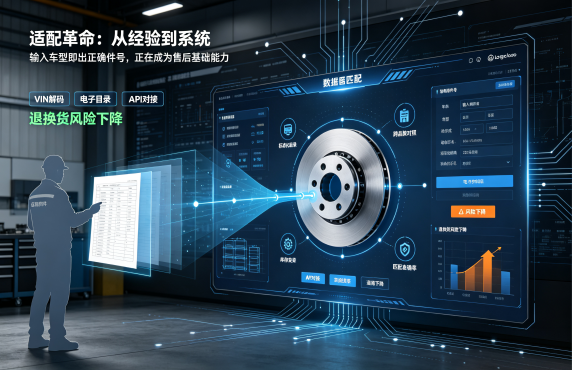
On the same platform, differences in drive configuration, caliper specifications, bolt patterns and ventilation designs can result in a single brake disc having over a dozen, or even several dozen, part numbers. For dealers and repair workshops, relying on human memory or paper catalogues is no longer practical; a single mismatch can lead to returns, lost working hours and safety risks.
Fitting accuracy is the cornerstone of trust
In the aftermarket, the consequences of brake components "failing to fit" or being "fitted incorrectly" are far more serious than for ordinary parts—as they are directly linked to road safety. Consequently, catalogue accuracy, cross-brand cross-referencing capabilities and VIN decoding accuracy have gradually become key indicators of a channel’s level of expertise.
Future competitiveness in after-sales service will not lie in "having large stock levels", but in "accurate matching". Data capabilities are replacing experience as the new infrastructure in the distribution of braking components.
Trends: From Experience to Systems
The industry is upgrading the parts-matching process from "the experience of seasoned technicians" to a "searchable data system": standardised coding, electronic catalogues and API integration with repair platforms are making it a standard service to "enter a vehicle model and receive the correct part number". Whoever can build a comprehensive and accurate database will be able to establish barriers to entry in the distribution channel.
Related News