


 Email
Email


 News Center
With the surge in sales of new-energy commercial vehicles, safety during long downhill braking has become an essential operational requirement
News Center
With the surge in sales of new-energy commercial vehicles, safety during long downhill braking has become an essential operational requirement
 Back to List
With the surge in sales of new-energy commercial vehicles, safety during long downhill braking has become an essential operational requirement


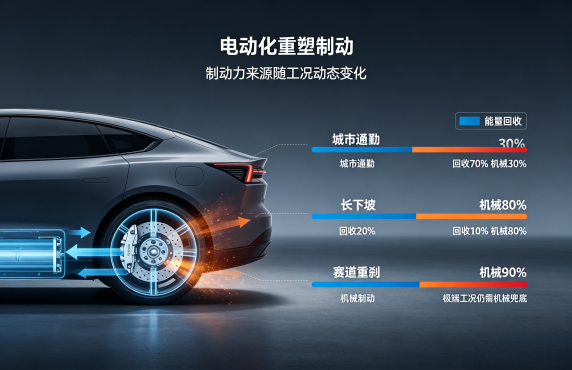
Over the past year or two, there has been a noticeable increase in the number of new-energy heavy goods vehicles and all-electric delivery vans operating in both long-haul transport and urban delivery scenarios. Whilst motor energy recovery can handle a significant portion of the deceleration, and drivers are keen to use it to conserve energy, one fact that is easily overlooked is that, during long downhill gradients and under conditions of continuous braking with heavy loads, mechanical braking remains the final line of defence for safety.

Energy recovery is not a panacea; mechanical braking remains the last resort.
Motor braking does indeed recover energy and reduce brake pad wear, but it depends on the battery charge level and the motor’s capacity. When decelerating continuously on a long downhill stretch, energy recovery alone is neither powerful enough nor sustainable for the battery. Ultimately, it is that pair of metal brake discs that provides the real safety net.
Why are long downhill stretches such a ‘brake killer’?
On mountainous routes such as those in Yunnan, Guizhou and Sichuan, as well as in southern Shaanxi, vehicles often descend under continuous braking for several minutes or even longer. As the temperature of the brake discs rises, the coefficient of friction decreases, resulting in a soft brake feel and increased stopping distances; in severe cases, brake judder may also occur. For fleet operators, this translates to higher safety risks and more frequent replacement of brake linings.
In addressing thermal degradation on long downhill gradients, the industry generally adopts a dual-pronged approach focusing on both materials and structure: on the materials side, a high-carbon alloy matrix is utilised to counteract degradation through a more stable high-temperature coefficient of friction; on the structural side, ventilation ducts and airflow guidance are employed to accelerate heat dissipation, supplemented by precision dynamic balancing to suppress high-temperature vibration. For corrosive environments such as humidity and de-icing agents, the selection of coatings and anti-corrosion processes are also incorporated into the overall design for heavy-duty operating conditions. It is only through this multi-pronged approach that ‘resistance to thermal degradation and heavy-load endurance’ has been transformed from a slogan into verifiable engineering results.
Looking ahead over the next two years, as the fleet of new-energy commercial vehicles continues to expand, demand for highly durable braking components will only become more pressing in scenarios such as mountainous trunk routes, short-haul port transport and internal transport within mines. Suppliers who can clearly explain and thoroughly address the issue of ‘heat’ will gain greater trust during this round of upgrades.
Related News